It has been five years since the world last heard from Eminem, but the
most incendiary rapper of all time is returning to the fray with perhaps
his most stunning album yet. In his only major interview to mark the
release of Relapse, he talks to Anthony Bozza about fame and his
fondness for serial killers, the addictions that nearly finished his
career and why he's in a better place now than ever before.
It has been five years since Eminem
last emerged from his Detroit compound with a new studio album, Encore.
By then, the rapper born Marshall Mathers III had established himself
as the most significant US artist of his generation – driving and
reflecting fierce debate in George Bush's America on racial and sexual
politics, violence, dysfunctional families and the pitfalls of
celebrity. He survived a traumatic childhood in the racially divided
lower-class suburbs of Detroit to win nine Grammy awards and an Oscar
(for best song, from the film 8 Mile, the loosely autobiographical tale
in which he starred); but even as critics and commentators belatedly
sought to embrace him, the United States Secret Service found itself
considering an investigation into the suggestion – on the 2003 track We
As Americans – that he had threatened the president's life.
No one could be insensate to Eminem, or Slim Shady, those aliases
born of a hip-hop tradition to which he had always been true. Shady
righted the wrongs the rapper had suff ered in life and ridiculed the
insincerity and injustice he saw all around him. But somewhere along the
way it seems as if holding a mirror up to his culture caused the real
Marshall Mathers to lose his way. The stuff of his life – from his
acrimonious relationships with his mother Debbie and his now twice
divorced ex-wife Kimberley Anne Scott (mother to his daughter Hailie ) –
fuelled lyrics that were often painfully detailed and explicit. But
following a greatest hits collection – with the ominous title Curtain
Call – in December 2005, Eminem disappeared from the limelight.
In the years since there have been endless rumours: Eminem was
struggling with drug addiction and weight gain; Eminem had put down the
microphone for good; Eminem intended to focus on acting; Eminem was too
paranoid to leave his home. The truth is mixed.
In his time away from the world at large, the 36-year-old star
struggled with an addiction to painkillers and sleeping pills that had
been with him for years. He gained weight, he grew depressed and he lost
the creative spark that had always driven him on. The murder of his
best friend and partner in rap, Proof – real name DeShaun Dupree Holton –
on 8 Mile Road in Detroit in April 2006 did nothing to help his
downward spiral.
I
first heard Eminem in 1998, when he was an unsigned rapper freestyling
on a Los Angeles radio show and I was on staff at Rolling Stone
magazine. I kept my eye out for him and a year later, when he signed to
Interscope records and was working with Dr Dre
– one of the most infl uential hiphop producers in history – I was
dispatched to interview him for a 250-word piece on the "novelty" video
for his surprise hit My Name Is. The Eminem I met then was on fi re,
with wit, with creativity and with a nothing-to-lose momentum that was
carrying him further to the top day-today than I think even he reali
sed. But as time went on, and over the course of several in-depth
interviews that saw me finally writing a book called Whatever You Say I
Am (Transworld) about his rise to fame and his cultural significance, I
saw the Eminem I knew change.
It wasn't just the stress of success and the complicated life he
chronicled so well in rhyme. In our last interview, circa the album The
Eminem Show in 2002, he had grown very visibly reserved; it was a trend
that seemed to continue in his subsequent dealings with the press and
public at large. Soon after, on Encore, his rhymes fell short of his
acerbic, acrobatic best. It sounded from the outside as if the wordsmith
who was never without a pen and a pad had grown bored of his craft.
In truth, he had. He was midway through a spiral that he has finally
turned around: he is now a year sober and ready to re-emerge with the
feverishly awaited Relapse. His voice is clear, his speech is focused
and for the first time in too long – to my ears at least – Eminem sounds
like the man he used to be. The outward signs are positive: rather than
remaining in his home studio to record, Eminem has built a new facility
in Detroit, full of his favourite vintage arcade games, where he now
prefers to work. And though he has not decided if he's going to tour
this album or Relapse II, a second studio release tentatively scheduled
for later this year, he has decided that he's ready to keep writing and
rapping rather than working behind the production desk for other
artists. It sounds as if Eminem has realised, once again, that rap saved
his life and that no one should turn their back on what they're born to
do – especially if they're given the chance to do it their way.
Eminem: Anthony, long time, no speak.
AB: Marshall Mathers, it is good to hear your voice.
Eminem: Yeah, I'm doing that "I am back" thing a little bit. Uh… cool. Is that all you need for this article?
AB: Definitely. Interview over. Thanks! Seriously, though, what made you want to put yourself out there again?
Eminem:
Honestly, I never really put the mic down. The problem was, as I'm
going to be explaining over and over again for a while, is that I had a
pretty bad drug problem. I was messing with Valium, Vicodin, Ambien and
anything to [help me to] sleep. Basically I'd take Vicodin to get me
through my day.
AB: You went to rehab for the first
time in August 2005 when you cancelled the European leg of the Anger
Management 3 tour, which was your first in three years.
Eminem:
Right. And when I went to rehab that time I wasn't ready to go. So when
I came out I relapsed pretty much right away, within a week. I was
still writing at that time and trying to do my producer thing. I was
sitting in rehab reflecting for the first time in a while. I felt like I
needed to pull back from the spotlight because it was getting out of
control. I mean, you could blame my drug problem on genetics, you could
blame it on my career and the way it took off, or you could just blame
it on me.
AB: Which did you blame it on?
Eminem:
I think more than anything it had to do with me. You know, my career
certainly played a hand in my drug use and how bad it actually got, but
it was also my own doing.
AB: It sounds like you got
a bit of perspective that first time in rehab, even if it ultimately
didn't work. What changes did you make?
Eminem: I
felt like I had to pull back from the spotlight. I thought I'd try to
produce records and work with artists from my label and shit like that. I
thought this would be my way to pull back a little bit and not be the
front man.
From the start, growing up in the Detroit suburb of Warren, Eminem
immersed himself in hip-hop culture, performing at high-school talent
shows under the moniker M&M (as in Marshall Mathers). While
promoting one of those shows he met Proof, the rapper who urged Eminem
to challenge himself and, along with some of the future members of the
group D12, inspired him to create his alter ego, Slim Shady. Eminem has
remained fiercely loyal to these roots – to his hometown and to the
rappers that made him the artist he is. It was clear, from my first trip
to Detroit with him back in 1999, that even though the city and many in
it hadn't shown him much love, he still had love for where he was from.
It makes sense that Eminem turned to producing his friends during his
darkest days – like his house and the city itself, they are his refuge.
AB: During your "retirement", you did release Eminem Presents: The Re-Up (2006), with Obie Trice and Proof and others...
Eminem: We
did do that album during that time… you have to excuse me if my memory
is a little blotchy from those four years. It's probably understandable
looking back at how much I was actually using. But yeah, that album came
out and it did what it did and came out how it came out. I never
stopped working, but I had a problem I was hiding. I guess it was a
combination of writer's block and being lazy, because I just didn't want
to write rhymes any more.
AB: Really? Every time
I've seen you since day one you've always had a note pad or a napkin or
something nearby that was always full of rhymes.
Eminem:
I don't know, I was just too lazy to write my rhymes so I started to do
the Jay-Z thing. I'd just go in and freestyle whenever I did a verse.
[But] I had writer's block. For the first time in my life I couldn't
write. I couldn't write a rhyme to save my life.
AB: That is shocking to me. I've seen you literally not be able to stop rhyming.
Eminem:
I mean, don't get me wrong, I could write rhymes. But I wasn't able to
write anything that was good and up to my standards. This went on for
two, probably three years. It was the worst case of writer's block.
Going through that I felt like shit. Me, personally, if I don't write
all the time, if a couple of weeks go by and I'm not writing, I feel
shitty. I need to write, just as little exercises to feel like I'm doing
something.
AB: So you must have felt completely strange.
Eminem:
It was the pills I was taking; they had my mood really fucked up. I was
already depressed and with the drugs it just became a vicious cycle of
depression. And as if my drug problem wasn't bad enough, when Proof died
it was like, "Son of a bitch, what I am going to do now?". I went
through a lot when he died. It was the worst time in my life. It just
gave me a real legitimate excuse, in my head at least, to use drugs. I
didn't care if my drug problem got worse at that point so I took more
pills. And the more I said fuck it and took more pills, the higher my
tolerance got. The higher my tolerance got, the more I needed those
pills in my body just to feel normal and not feel sick. It's a vicious
cycle. I got over it all last year. I ended up coming out of all that
shit that was cluttering my mind and as I came up out of the haze from
the pills and everything, shit started to get clearer.
I
met Eminem's long-serving manager and close friend Paul Rosenberg in
the Shady Records offices in Manhattan, before being taken on a ride in a
well-appointed Cadillac Escalade to listen to the new album at full
volume. Though the first single We Made You, with its pot-shots at
Lindsay Lohan, Amy Winehouse and Sarah Palin, reintroduced the clowning
Eminem to the world, the album as a whole is a darker, more lyrically fi
erce aff air. In fact, Relapse contains, hands down, some of the best
work he's ever done. That doesn't mean it's full of Grammy-ready
collaborations or radio-friendly jingles. The subject matter is ripe
with humour and horror, and injected with a dark intensity.
Getting there wasn't easy: after a few false starts, the record
finally took shape in the course of a recording session with his old
amanuensis Dr Dre. It didn't happen in Detroit, nor in Dre's studio in
Los Angeles, but in Orlando, Florida.
Eminem: I was nervous about it. I had called him and
told him I had something for him so I was nervous. You see, he and I
had got together five or six times over the past few years and literally
left the studio with nothing.
AB: Are you serious? The two of you have such chemistry, you really must have been in bad shape.
Eminem:
Yeah. I was really nervous about that trip. I had let him down, like,
five times. I wasn't sure if we were going to work on his record or
mine, but I didn't want to get down to Orlando and not have anything
again. A couple of weeks before the trip I was still pretty new to my
sobriety. I was a few months clean but my mood was elevating and my mind
was getting clearer. I started writing more and I told Dre that I had
been writing songs without beats. I was making beats in my head and
writing lyrics down just like I used to do. At that point I had a couple
of songs and a few loose verses. In hindsight I was doing mind
exercises, getting myself back into shape. I wasn't sure if I was ready
but I called him anyway and was like, "Yo, homie, I think I'm starting
to come out of this writer's block." He was like, "All right. That's
what I like to hear." When I got to Orlando we recorded a batch of songs
over two weeks. We did 11 songs and when we were done I felt like I did
when we did the first two records. It was that same feeling, so the
word "relapse" just kept playing over and over in my mind. It all made
sense.
AB: You were relapsing back into the old ways of being yourself, just without the drugs.
Eminem:
Yeah. I'd had conversations with Dre over the years about what people
wanted f rom me. I was hearing all these things about what if Em comes
back and the different ways he needs to reinvent himself as a completely
diff erent person. Dre was just like, "Man, people want to see you,
they just want to hear you get the fuck out there again." I don't know
if it was the first, second, third time he said it to me but then it
just clicked. Like, "He is right." I don't feel like I need to reinvent
myself, I feel like I just need to go back to doing what made me me in
the first place. We did 11 songs and then I went back to Detroit and I
was worried about that. I was going home and I thought I'd feel
uninspired to write. I thought I'd need to leave home for my mind to
expand. But we came back and it never stopped. Once I got sober, man, it
was a whole shit storm – these thoughts that I could not control. That
really made me feel like me again. I'd lay down to go to bed and think
of three lines I had to get up to write down before I forget them. It
was that sort of thing.
AB: Did you change up your routine to keep you from falling back into your old ways?
Eminem:
I had been recording a lot of shit at home during the past few years
and got real comfortable doing that. So I got a new studio and started
recording there. I didn't like doing vocals and recording at that studio
at first – it took me a while to break it in, but once it got broken
in, I liked it better. Now I don't record at home at all any more.
Dre
produced every track bar one on Relapse, many with Eminem as
co-producer. The exception is Beautiful, the most revealing tune on the
album, produced by Eminem alone. It follows the tradition of cuts such
as Rock Bottom and Hailie's Song in frankly detailing Eminem's
depression and chemically enhanced ennui. Its anthemic style is equally
different from the rest of the album, too; it's more mid-tempo rock song
than window-rattling rap track.
Eminem: It was a relief for me to not worry about
the beats and strictly focus on writing and what the hell I wanted to
say. It took a lot of the stress off. But Beautiful is a different
story. That song is the only one out of a whole batch of songs –
probably three or four albums' worth of material – that I recorded in
the time I was gone. I did all of that when I wasn't sober and that is
literally the only song that's on this record. I don't know if any of
the others are going to make it to Relapse II, which I plan to release
later this year, because I haven't picked out those songs yet.
AB: Is this the best of the bunch? Or is it the only one you're willing to let the world hear?
Eminem:
It's the only one I could actually listen to and feel OK about. It
brings me back to a time when I was really depressed and down, but at
the same time it reminds me of what that space is like and what never to
go back to. There is a lot of honesty in that song that I wouldn't want
to just throw away. I started writing the first verse and half of the
second when I was in rehab going through detox. I didn't have a beat in
my head or anything like that… I wrote the verse and just knew I wanted
it to be a bounce-style, I guess. I got that first bit out and finished
it when I got out of rehab, when I relapsed right back into taking
pills. If you listen to that song and how it starts off, I'm just so
fucking depressed.
AB: Where were you exactly when you wrote that?
Eminem:
I was sitting on the end of the bed in detox, not fully committed to it
and not fully detoxed. They give you medicine to make your detox not as
rough. I wrote it during that period – the first two days. I was
sitting there not knowing where I wanted to be in my career. I didn't
even know if I wanted a career any more, because this shit was too much.
It just wasn't worth it.
The second single from the album, 3am, is different: it marks a
return to the horror fantasy that Eminem does so well. His battle rap
style, born of lyrically battling rivals in high school lunch rooms and
Detroit clubs, is Eminem's trademark. Whatever his subject, Eminem takes
it apart, deconstructing it lyrically – usually with an extra dose of
ultra-violence – as if it's his opponent. His skill with rhymed
evocative language and a fearless pursuit of shock and indecency has
outraged many and made fans of even more.
On
Relapse, Eminem is unrepentant in this regard: on this single he is out
to maim and offend. And if anyone wonders what he's been watching on TV
late at night, they shouldn't be surprised to hear he's been catching a
lot of serial killer fi lms – albeit in a positive way. Really.
AB: I have to say that, Beautiful aside, there's a
real serial killer theme running through this album. Did you have
Silence of the Lambs on loop in your house?
Eminem: I
did find myself watching a lot of documentaries on serial killers. I
mean, I always had a thing for them. Oh, that's not twisted in itself at
all, right? I've always been intrigued by them and watching movies like
that, and I found that going back through my DVD collection and
watching movies about killers sparked something in me. The way a serial
killer's mind works, just the psychology of them, is pretty fucking
crazy. I was definitely inspired by that, but most of that imagery came
from my own mind. I did everything I could to relapse into the old me.
When you relapse you go into your old ways harder than before.
AB: Is that where the story in 3am came from?
Eminem: Yeah,
in that song I relapse in a rehab facility or something like it. I just
black out and fucking kill everybody. I was trying to create a triple
entendre with the [album] title: relapsing literally, going back to the
old days – just blacking the fuck out and killing everyone. I wanted to
paint a picture for the listener, to make them feel like they are in the
story and part of it as each line progresses.
AB: Are you angry at life right now?
Eminem:
Honestly, I'm not really angry at anything right now. I'm OK with my
life and what's going on right now. This is not really an emotionally
driven album. There are a couple of songs, Beautiful being one of them,
that touch on where I am emotionally, but it goes there without getting
too dark. The overall theme of the record is to have a centre. I feel
like I lost that on my last albums. Encore is a good record but I don't
feel like it was a great record for me. It wasn't quite up to what I
feel like my personal standards are for myself. It wasn't all that I'm
capable of doing.
AB: Are you saying that Encore falls short musically, lyrically or both?
Eminem:
It feels a little too self-loathing to me. When I go back and listen to
it… it just feels like I'm pissing and moaning about whatever. It
sounds like in my head I feel like I have all these things to piss and
moan about. And maybe I did, maybe I didn't, I don't know, but to
actually bring that kind of shit to the forefront like that, I just
don't agree with it. I guess to me now it feels like I beat up the
subject of what was me. That's what that record's overall theme feels
like. Even Curtain Call feels like that was me then and I guess it was.
That is where I was at then. AB: Are you at the point in your sobriety where you look back at those albums and trace how you were changing at all? Eminem:
Oh definitely. Encore wasn't the start of my drug use but it was the
start of the progression of my addiction. It really went to the next
level between The Eminem Show and Encore – that's when it started
progressing from recreation to a real problem. Even though I knew it
inside, I would never let on that it was a problem. Obviously I was
pretty good at hiding it because I was pretty busy. I was a functioning
addict. I knew in my mind, "I'm taking these pills just for the fuck of
it now." I was taking them and I needed more and more. When I think back
on my mental state back then – "Oh, I wrote this because of this" – I
can see what I was going through. Sedative drugs like Valium and Vicodin
and Ambien, they certainly put a cloud over your head. They put a
dumbbell in your mood. If something is bad in the first place, it's
going to seem so much worse than it even is. A normal, thinking person
would approach a tough situation in life like, "Wow! This is a really
fucked-up time period that I'm experiencing right now but I'll get
through it." My attitude was, "I'm never getting through with it. This
is the most horrible shit." I was concerned with things like "I can't go
to the fucking mall any more, I can't go to the gas station, I can't
pump my own gas, how fucked up is that? I can't walk into a 7-11 store!"
I couldn't do those things any more and all I did was sit and bitch and
complain about it.
He
may have complained but he wasn't imagining it: Eminem occupies a
rarefied realm of celebrity that crosses all borders. But success didn't
come to him until his late 20s, only then arriving overnight. The first
24 hours I spent with Eminem saw us travel to three club engagements in
New York City – booked well before the explosion of interest that
followed the release of his debut single. The first gig was at a
sold-out all-ages show, where his fans were so rabid to see him that
their mass presence stopped traffic outside the venue. Police were
required to escort us out through an alley and to part the crowd so that
our car could leave. When we returned to Detroit just a few days later,
however, I saw the reality of where he really came from: there was an
eviction notice on the trailer he still called home and in Gilbert's
Lodge, the restaurant where he'd worked for years, many of his former
co-workers did everything short of mock his new-found success to his
face. That was 10 years ago and the stakes have risen exponentially.
Eminem has always been a private person; in one of our earliest
interviews, when the attention coming his way was just starting to sink
in, he told me that all he wanted out of his career was to make a living
and support his family. He wasn't after fame, he wasn't after
celebrity, he just wanted to make enough money rapping to get by. He
also said he wasn't seeking controversy. But like everything else that
has ever been a challenge to Eminem, he's shrunk from none of it.
AB: The paparazzi and all that comes with fame has driven a lot of people crazy.
Eminem:
Yeah, but that's bullshit. Because would I rather be working back at
Gilbert's Lodge for eight bucks an hour cooking and doing dishes having
never made it? Or would I rather be like this dealing with my life as it
is now? Like, what really do I have to piss and moan about? I mean, I'm
not saying that I have the easiest fucking job in the world, but it's
certainly better than what I was doing. Would I have been a happier
person if I had never made it? Fuck no, I wouldn't! I'd be ten billion
times worse than I could even imagine. So at the end of the day, what do
I really have to complain about?
AB: Perhaps not so
much. On earlier albums you did complain a lot about your family life. I
noticed a lack of that on this album. Is that another change you've
made?
Eminem: Yeah. I'm probably going to keep my
family life personal from now on. The kids are old enough now – I just
want to let them be kids. I don't want to comment on them too much.
They're at an age where I just want to let them be kids.
In
the years that Eminem has been away, hip-hop has grown more
candy-coated than ever. Aside from a few artists, the majority of recent
rap records have focused more on the dancefloor than the lyrical weight
that made artists such as Tupac and the Notorious BIG international
icons . No one else can simultaneously appeal to die-hard fans of rhyme,
rock fans, pop fans, young and old quite like Eminem. I'd suggest that
no one else could have made an album like Relapse, either.
AB: What do you have to say on the state of hip-hop at the moment?
Eminem: Hey, do you mind holding on for two seconds? I've got to piss really bad.
AB: Wait, is that your answer to my question? Are you going to go piss on hip-hop?
Eminem: No,
man! I've been holding but I can't hold it no more! [A few minutes
pass]. Ahh, I'm a brand new man! OK, hip-hop. Well, from what I heard on
the radio while I was away the past few years I feel hip-hop went to a
bad place. It got watered down lyrically, contentwise, everything. But
at the same time there have been artists like T.I. And Lil' Wayne and
Kanye [West], they've all been here doing their thing. Those guys
elevated their game. All of that is making me a fan of rap again. It
feels like people are starting to actually give a shit about the craft
and about writing.
AB: What are you doing when you're not working to stay out of trouble these days?
Eminem: Well, I'm working all the time to stay out of trouble! Aside from spending time with the kids, it's all work for me right now.
AB: Hip-hop needs some records fans can sink their brains into.
Eminem: You
know what though? Hiphop has always been like that. When I was growing
up, there was LL [Cool J] and Run DMC and there was Big Daddy Kane and
KRS-One. It was the few and far between that made the game interesting.
There were plenty of rappers out there that were wack but they had a
purpose. They just made you appreciate the good ones so much more. If
there wasn't that variety, you wouldn't actually know it when you heard
somebody that was really good. Hip-hop is ever changing but you'll always have the pack. And you'll always have those people who are separated from the pack.
Monday, 12 September 2016

Monday, 1 February 2016
Lana del Rey is just the latest woman to be attacked by Eminem
His latest violent rap in CXVPHER Freestyle shows how little our attitudes to women have changed in the 15 years since he shot to fame
Did you know that Eminem has used his lyrics to spew something misogynistic toward a female celebrity? It’s true, just like in 2000 and again in 2009, and really, in any year in which Eminem has been a mainstream performer.
In a new track in support of the upcoming Shady Records compilation, Eminem targets Lana del Rey in a reference to the violent attack on Janay Rice from her husband, NFL star Ray Rice. In the verse, Eminem says: “Play nice? Bitch I’ll punch Lana Del Rey right in the face twice, like Ray Rice in broad daylight in the plain sight of the elevator surveillance/ ’Til her head is banging on the railing, then celebrate with the Ravens.”
Eminem’s uber-misogynistic lyric toward Lana del Rey is neither shocking nor surprising. For 15 years, he has used our culture’s feigned anger toward acts of misogyny, and our obsession with celebrity, as a shortcut to staying relevant.
We pretend to be shocked by his words, and yet the world remains as misogynistic as ever. He causes temporary controversy until we move on to something else, forgetting why we were upset in the first place. As a method of inserting himself into the current cultural conversations surrounding women (and in particular, women in music), attacking women in his singles offers instant selling publicity.
The earliest example came in the The Real Slim Shady, the lead single from his second major label album. In the single, Eminem attacks Britney Spears and, particularly, Christina Aguilera: “Christina Aguilera, better switch me chairs / so I can sit next to Carson Daly and Fred Durst / and hear ‘em argue over who she gave head to first.”
This gossipy, misogynous abuse of what were then two of the world’s most famous women re-established Eminem at his most critical moment as a performer – his “sophomore” record. The accompanying video, featuring Spears and Aguilera lookalikes, exacerbated the insult and was a particularly smart touch.
After a nearly five-year break from the spotlight following a series of personal tragedies, Eminem returned to the music scene in 2009 and immediately used the same tactic. His 2009 album, Relapse, included the single We Made You, which took on targets including Lindsay Lohan, Jessica Simpson, Amy Winehouse, Spears (again) and Kim Kardashian.
Eminem’s attacks fit a tight mould: celebrity-directed, often homophobic, and usually geared toward women. Whether aimed at Aguilera, Kardashian or Del Rey in 2014, they are a quick grab at inserting himself into modern culture. These women are also, usually, reflective of major social changes, whether they be the rise of hypersexuality and teen pop (Aguilera), the public embrace of celebrity for celebrity (Kardashian) or the embrace of the artistic and weird (Del Rey).
For someone who traffics in cultural relevancy and cachet, Del Rey is a smart target for Eminem. Over-the-top, outrageous and with an eerie beauty, she challenges our understanding of celebrity and American culture. But make no mistake. If this was two years ago and Lady Gaga was still on top of the world, Eminem would have merely slipped in her name instead of Del Rey’s.
Eminem’s words seem less like a brazen representation of his true, malicious feelings, and more like an attempt to touch on two very different, yet comparable intersections in contemporary American culture: our desire to be shocked and our obsession with celebrity.
He continues to traffic in misogyny (and homophobia – earlier in the new verse, he criticises Anderson Cooper) because he knows it will give him attention. What better way to keep your name in other people’s mouths than to say the most despicable, hurtful things imaginable? And yet, as long as we give him attention, as long as we act as if what he says is any way different or more shocking than the still-troubling, discriminatory, and offensive world we live in, he will still find “success” in his “controversies”.
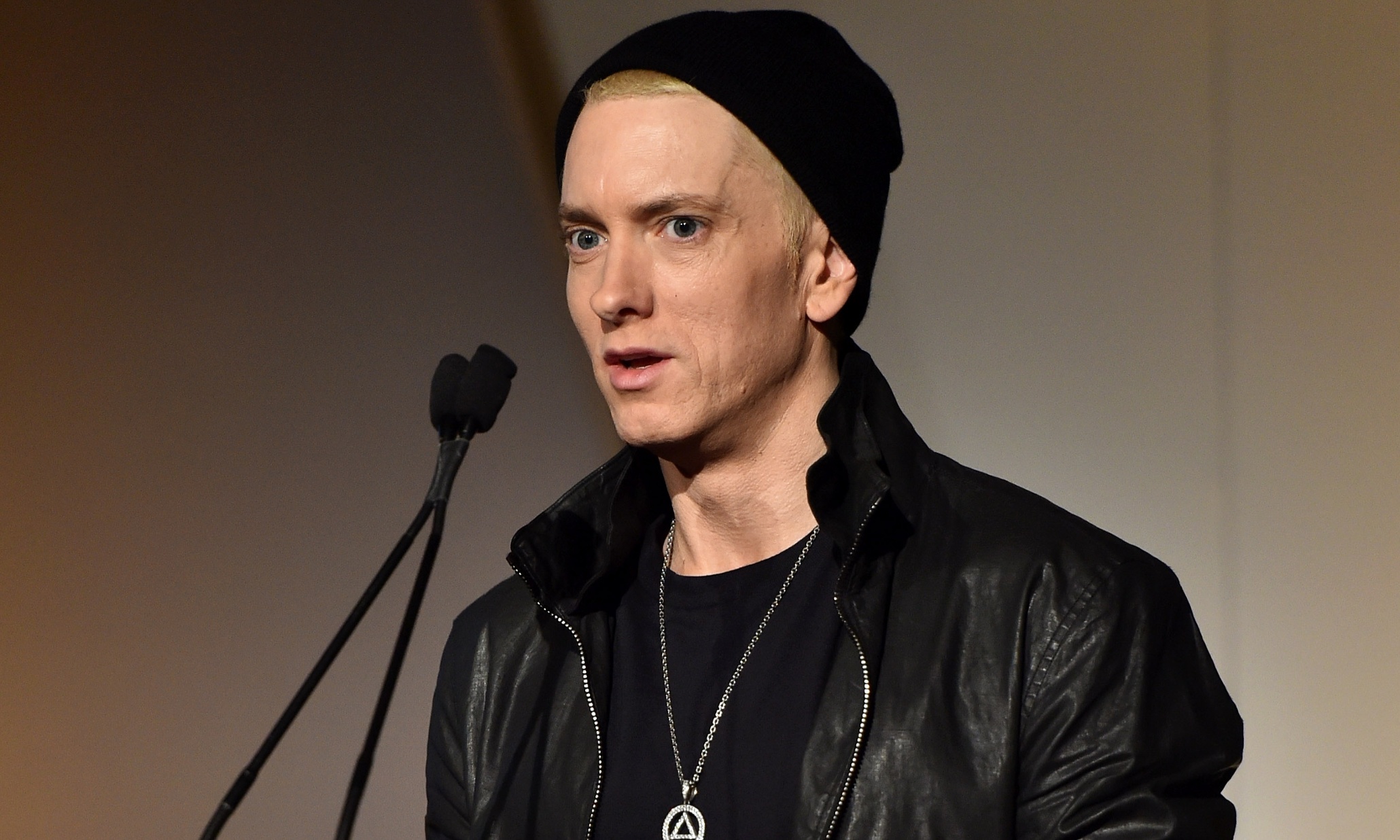
Bully pulpit: Eminem at WSJ’s Innovator of the Year awards in New York. Photograph: Mike Coppola/Getty Images
Did you know that Eminem has used his lyrics to spew something misogynistic toward a female celebrity? It’s true, just like in 2000 and again in 2009, and really, in any year in which Eminem has been a mainstream performer.
In a new track in support of the upcoming Shady Records compilation, Eminem targets Lana del Rey in a reference to the violent attack on Janay Rice from her husband, NFL star Ray Rice. In the verse, Eminem says: “Play nice? Bitch I’ll punch Lana Del Rey right in the face twice, like Ray Rice in broad daylight in the plain sight of the elevator surveillance/ ’Til her head is banging on the railing, then celebrate with the Ravens.”
Eminem’s uber-misogynistic lyric toward Lana del Rey is neither shocking nor surprising. For 15 years, he has used our culture’s feigned anger toward acts of misogyny, and our obsession with celebrity, as a shortcut to staying relevant.
We pretend to be shocked by his words, and yet the world remains as misogynistic as ever. He causes temporary controversy until we move on to something else, forgetting why we were upset in the first place. As a method of inserting himself into the current cultural conversations surrounding women (and in particular, women in music), attacking women in his singles offers instant selling publicity.
The earliest example came in the The Real Slim Shady, the lead single from his second major label album. In the single, Eminem attacks Britney Spears and, particularly, Christina Aguilera: “Christina Aguilera, better switch me chairs / so I can sit next to Carson Daly and Fred Durst / and hear ‘em argue over who she gave head to first.”
This gossipy, misogynous abuse of what were then two of the world’s most famous women re-established Eminem at his most critical moment as a performer – his “sophomore” record. The accompanying video, featuring Spears and Aguilera lookalikes, exacerbated the insult and was a particularly smart touch.
After a nearly five-year break from the spotlight following a series of personal tragedies, Eminem returned to the music scene in 2009 and immediately used the same tactic. His 2009 album, Relapse, included the single We Made You, which took on targets including Lindsay Lohan, Jessica Simpson, Amy Winehouse, Spears (again) and Kim Kardashian.
Eminem’s attacks fit a tight mould: celebrity-directed, often homophobic, and usually geared toward women. Whether aimed at Aguilera, Kardashian or Del Rey in 2014, they are a quick grab at inserting himself into modern culture. These women are also, usually, reflective of major social changes, whether they be the rise of hypersexuality and teen pop (Aguilera), the public embrace of celebrity for celebrity (Kardashian) or the embrace of the artistic and weird (Del Rey).
For someone who traffics in cultural relevancy and cachet, Del Rey is a smart target for Eminem. Over-the-top, outrageous and with an eerie beauty, she challenges our understanding of celebrity and American culture. But make no mistake. If this was two years ago and Lady Gaga was still on top of the world, Eminem would have merely slipped in her name instead of Del Rey’s.
Eminem’s words seem less like a brazen representation of his true, malicious feelings, and more like an attempt to touch on two very different, yet comparable intersections in contemporary American culture: our desire to be shocked and our obsession with celebrity.
He continues to traffic in misogyny (and homophobia – earlier in the new verse, he criticises Anderson Cooper) because he knows it will give him attention. What better way to keep your name in other people’s mouths than to say the most despicable, hurtful things imaginable? And yet, as long as we give him attention, as long as we act as if what he says is any way different or more shocking than the still-troubling, discriminatory, and offensive world we live in, he will still find “success” in his “controversies”.
Monday, 11 January 2016
When You're Asked about Eminem
1. Eminem's fans argue that his raps about raping, torturing, and murdering women are not meant to be taken literally. "Just because we listen to the music doesn't mean we're gonna go out and rape and murder women. We know it's just a song." But thoughtful critics of Eminem do not make the argument that the clear and present danger of his lyrics lie in the possibility that some unstable young man will go out and imitate in real life what the artist is rapping about. (While possible, this is highly unlikely.)
Rather, one of the most damaging aspects of Eminem's violent misogyny and homophobia is how normal and matter-of-fact this violence comes to seem. Rapping and joking about sex crimes has the effect of desensitizing people to the real pain and trauma suffered by victims and their loved ones. The process of desensitization to violence through repeated exposure in the media has been studied for decades. Among the effects: young men who have watched/listened to excessive amounts of fictionalized portrayals of men's violence against women in mainstream media and pornography have been shown to be more callous toward victims, less likely to believe their accounts of victimization, more willing to believe they were "asking for it," and less likely to intervene in instances of "real-life" violence.
2. Marshall Mathers is a bully with a microphone. His public persona - as well as some well-publicized incidents in his "private" life - fit many of the predictable characteristics of men who batter. Especially the folklore about his famously difficult childhood. Narcissistic batterers often paint themselves as the true victims. In fact, many of his young fans, male and female, reference his abusive family life to explain his rage. Batterer intervention counselors hear this excuse every day from men who are in court-mandated programs for beating their girlfriends and wives. "I had a tough childhood. I have a right to be angry," or "She was the real aggressor. She pushed my buttons and I just reacted." The counselors' typical answer: "It is not right or ok that you were abused as a child. You deserve our empathy and support. But you have no right to pass on your pain to other people."
3. Eminem's defenders - including a number of prominent music critics -- like to argue that his ironic wit and dark sense of humor are lost on many of his detractors, who supposedly "don't get it." This is what his predominantly young fans are constantly being told: that some people don't like the likeable "Em" because they don't get him, the personae he's created, his outrageously transgressive humor. In comparison, his fans are said to be much more hip, since they're in on the joke. One way to respond to this is to say "We get it, alright. We understand that lyrics are usually not meant to be taken literally. And we think we have a good sense of humor. We just don't think it's funny for men to to be joking aggressively about murdering and raping women, and assaulting gays and lesbians. Just like we don't think that it's funny for white people to be making racist jokes at the expense of people of color. This sort of 'hate humor' is not just harmless fun. Millions of American girls and women are assaulted by men each year. According to the U.S. surgeon general, battering is the leading cause of injury to women. We're seeing a large increase around the country in teen relationship violence. Gay-bashing is a serious problem all over the country. Sorry if we don't find that funny."
4. Eminem has been skillfully marketed as a "rebel" to whom many young people - especially white boys -- can relate. But what exactly is he rebelling against? Powerful women who oppress weak and vulnerable men? Omnipotent gays and lesbians who make life a living hell for straight people? Eminem's misogyny and homophobia, far from being "rebellious," are actually extremely traditional and conservative. As a straight white man, Marshall Mathers would actually be much more of a rebel if he rapped about supporting women's equality and embracing gay and lesbian civil rights. Instead, he is only a rebel in a very narrow sense of that word. Since he offends a lot of parents, kids can "rebel" against their parents' wishes by listening to him, buying his cd's, etc. The irony is that by buying into Eminem's clever "bad boy" act, they are just being obedient, predictable consumers. ("If you want to express your rebellious side, we have just the right product for you! The Marshall Mathers LP! Come get your Slim Shady!) It's rebellion as a purchasable commodity.
Rather, one of the most damaging aspects of Eminem's violent misogyny and homophobia is how normal and matter-of-fact this violence comes to seem. Rapping and joking about sex crimes has the effect of desensitizing people to the real pain and trauma suffered by victims and their loved ones. The process of desensitization to violence through repeated exposure in the media has been studied for decades. Among the effects: young men who have watched/listened to excessive amounts of fictionalized portrayals of men's violence against women in mainstream media and pornography have been shown to be more callous toward victims, less likely to believe their accounts of victimization, more willing to believe they were "asking for it," and less likely to intervene in instances of "real-life" violence.
2. Marshall Mathers is a bully with a microphone. His public persona - as well as some well-publicized incidents in his "private" life - fit many of the predictable characteristics of men who batter. Especially the folklore about his famously difficult childhood. Narcissistic batterers often paint themselves as the true victims. In fact, many of his young fans, male and female, reference his abusive family life to explain his rage. Batterer intervention counselors hear this excuse every day from men who are in court-mandated programs for beating their girlfriends and wives. "I had a tough childhood. I have a right to be angry," or "She was the real aggressor. She pushed my buttons and I just reacted." The counselors' typical answer: "It is not right or ok that you were abused as a child. You deserve our empathy and support. But you have no right to pass on your pain to other people."
3. Eminem's defenders - including a number of prominent music critics -- like to argue that his ironic wit and dark sense of humor are lost on many of his detractors, who supposedly "don't get it." This is what his predominantly young fans are constantly being told: that some people don't like the likeable "Em" because they don't get him, the personae he's created, his outrageously transgressive humor. In comparison, his fans are said to be much more hip, since they're in on the joke. One way to respond to this is to say "We get it, alright. We understand that lyrics are usually not meant to be taken literally. And we think we have a good sense of humor. We just don't think it's funny for men to to be joking aggressively about murdering and raping women, and assaulting gays and lesbians. Just like we don't think that it's funny for white people to be making racist jokes at the expense of people of color. This sort of 'hate humor' is not just harmless fun. Millions of American girls and women are assaulted by men each year. According to the U.S. surgeon general, battering is the leading cause of injury to women. We're seeing a large increase around the country in teen relationship violence. Gay-bashing is a serious problem all over the country. Sorry if we don't find that funny."
4. Eminem has been skillfully marketed as a "rebel" to whom many young people - especially white boys -- can relate. But what exactly is he rebelling against? Powerful women who oppress weak and vulnerable men? Omnipotent gays and lesbians who make life a living hell for straight people? Eminem's misogyny and homophobia, far from being "rebellious," are actually extremely traditional and conservative. As a straight white man, Marshall Mathers would actually be much more of a rebel if he rapped about supporting women's equality and embracing gay and lesbian civil rights. Instead, he is only a rebel in a very narrow sense of that word. Since he offends a lot of parents, kids can "rebel" against their parents' wishes by listening to him, buying his cd's, etc. The irony is that by buying into Eminem's clever "bad boy" act, they are just being obedient, predictable consumers. ("If you want to express your rebellious side, we have just the right product for you! The Marshall Mathers LP! Come get your Slim Shady!) It's rebellion as a purchasable commodity.
But if you focus on the contents of his lyrics, the "rebellion" is empty. Context is everything. If you're a "rebel," it matters who you are and what you're rebelling against. The KKK are rebels, too. They boast about it all the time. They fly the Confederate (rebel) flag. But most cultural commentators wouldn't nod approvingly to the KKK as models of adolescent rebellion for American youth because the *content* of what they're advocating is so repugnant. (And Eminem would be dropped from MTV playlists and lose his record contract immediately if he turned his lyrical aggression away from women and gays and onto people of color.) Is it possible that when "responsible" journalists and other entertainers embrace Eminem as a "rebel," it says something about *them,* and their gender and sexual politics, including how seriously they regard the problems of rape, wife-murder, and young men's violence against gays and lesbians?
5. Some of Eminem's admirers argue that his detractors don't respond well to the anti-social disdain and nihilism -- found in parts of young, white, working-class culture -- that the now multi-millionaire Eminem captures so skillfully in his raps. There might be some truth to this. But it is also true that the music, television, and movie industries are constantly developing marketing strategies to appeal to the lucrative markets of young consumers of all socioeconomic classes. In recent years, one of the most successful of these strategies involves praising young consumers for how media-savvy they are, especially in contrast with their parents and other older people. Then, as the young consumers absorb the props for their sophistication, they are sold cd's, movies, and myriad other products whose sensibilities supposedly prove how "savvy " their purchasers really are. This process would be laughable were it not for the fact that some of the products (e.g. slasher movies, Eminem) often simply reinforce existing cultural prejudices and animuses.
What this process makes painfully clear is the crying need for more media literacy education in the schools. Young people need to be given analytic tools to understand the ways in which they are being manipulated by a consumer culture that doesn't care about them or their struggles to lead rewarding lives, free from abuse and violence. Wealthy corporations in the consumer culture, including the record companies that have profited handsomely from Eminem, only care about young people's money. To them, it's all about the Benjamins (the money). The rest of us who care about kids need to do a better job of making that clear.
5. Some of Eminem's admirers argue that his detractors don't respond well to the anti-social disdain and nihilism -- found in parts of young, white, working-class culture -- that the now multi-millionaire Eminem captures so skillfully in his raps. There might be some truth to this. But it is also true that the music, television, and movie industries are constantly developing marketing strategies to appeal to the lucrative markets of young consumers of all socioeconomic classes. In recent years, one of the most successful of these strategies involves praising young consumers for how media-savvy they are, especially in contrast with their parents and other older people. Then, as the young consumers absorb the props for their sophistication, they are sold cd's, movies, and myriad other products whose sensibilities supposedly prove how "savvy " their purchasers really are. This process would be laughable were it not for the fact that some of the products (e.g. slasher movies, Eminem) often simply reinforce existing cultural prejudices and animuses.
What this process makes painfully clear is the crying need for more media literacy education in the schools. Young people need to be given analytic tools to understand the ways in which they are being manipulated by a consumer culture that doesn't care about them or their struggles to lead rewarding lives, free from abuse and violence. Wealthy corporations in the consumer culture, including the record companies that have profited handsomely from Eminem, only care about young people's money. To them, it's all about the Benjamins (the money). The rest of us who care about kids need to do a better job of making that clear.
EMINEM'S GENERAL INFORMATION
Early Life
Moving and school problems
Eminem was born named, Marshall Bruce Mathers III . Eminem is just his stage name . He was born in Saint Joesph, Missouri. Marshall and his mom moved constantly as he was growing up. His dad abandoned him when he was just nine months old. Marshall went to many schools because he moved so often. He attended Lincoln high school in Warren, Michigan. He had to redo the ninth grade three times. He had to redo do ninth grade because he would ditch to go to rap battles and hang out with friends. It may be hard to believe, but he was pretty smart (school smart horrible at making decisions). Eventually he dropped out because he met Kim(his wife later on in life) and had a kid (Hailie). If Eminem didn't drop out of school he probably would have had a good chance of going to college.
Early music groups
Many people don't really know how Eminem's career began. Well it all started when Marshall became interested in hip hop, performing amateur raps at age 14 under the pseudonym "M&M". Joining the group "Bassmint Productions also helped him . Bassmint Productions wasn't the only group he was in though. He also joined a group called D12. D12 sold over 10 million albums worldwide!! D12 wasn't always famous though. When they first started they weren't offered a record deal so they went their separate ways. Later on Eminem got discovered and got the group back to together.
Did you know..........
Eminem says that he enjoys the attention, but not all the time
because sometimes he wants to be alone with his family.
He talks about it a lot in the song “The Way I Am”. He
expresses it a lot in his music.
Music career
Eminem has been into music since he was kid. He started with small music groups then got discovered. Eminem's first album was Infinite released in 1996. Then 7 others followed. The names of them are:The Slim Shady LP, The Marshall Mathers Lp, The Eminem Show,Encore,Musical Hiatus,Relapse, and Recovery which is the most recent album. Eminem writes all of his music. He gets the ideas from life experiences. Some people think that his music is depressing, but if you really think about it, it's poetry. Eminem has tons of hit singles. If I tired to name them all it would take up the whole page. The first one was,"My Name Is". In the song he is basically introducing his alter ego , Slim shady. Eminem sometimes has trouble releasing albums because the record companies say they aren't good enough or they won't sell. He talks about it In the song "The Way I Am". He never gives up though. He keeps trying. He might get frustrated, but he never gives up.
Acting career
Not many people know about Eminem's acting career. He's been in a total of 8 films. 8Mile is probably one of the more famous ones. In 8Mile he plays Jimmy B-Rabbit. He performed 5 songs in the movie. He wasnominated for over 20 awards because of that movie. He won most of them. Eminem guest stared in a couple of other movies and shows,but none of them were as good as 8Mile.
Family Kids
Marshall has one daughter that he had with Kim, and her name is Hailie. He adopted Kim's sister's daughter. Her name is Alaina. He also adopted Kim's daugher, Whitney that she had before she was with him. Marshall loves his kids a lot. He mentions their names in some of his songs. Mostly Hailie though. Marshall has full custody of the kids because Kim had problems with drugs. He says that he misses them a bunch when he's on tour.
Wife
Marshall married Kimberly Scott in 1999.They had an on and off relationship . They met in high school. He dropped out for her. In 1996 they had Hailie. She sued Marshall for a making a violent song about her called "Kim" . Eventually they got divorced in 2001.In 2006 they got remarried. Then in December of the same year they got a final divorce. Marshall got full custody of the kids because of Kim's drug problems. In some of his songs he still talks about. He probably misses her. Even though it was her fault they got an divorce.
If you could learn anything from Eminem it would be to never give up. He has gone through a lot of things over the past years, but still made his goal to become a famous music artist. If he would have gave up on on his goals, there would never be a Eminem. His life may have had a lot of twist and turns,but he got through them and still succeeded. It is so amazing that he has 8 albums!! Not that many music artist are able to produce that many albums.
Moving and school problems
Eminem was born named, Marshall Bruce Mathers III . Eminem is just his stage name . He was born in Saint Joesph, Missouri. Marshall and his mom moved constantly as he was growing up. His dad abandoned him when he was just nine months old. Marshall went to many schools because he moved so often. He attended Lincoln high school in Warren, Michigan. He had to redo the ninth grade three times. He had to redo do ninth grade because he would ditch to go to rap battles and hang out with friends. It may be hard to believe, but he was pretty smart (school smart horrible at making decisions). Eventually he dropped out because he met Kim(his wife later on in life) and had a kid (Hailie). If Eminem didn't drop out of school he probably would have had a good chance of going to college.
Early music groups
Many people don't really know how Eminem's career began. Well it all started when Marshall became interested in hip hop, performing amateur raps at age 14 under the pseudonym "M&M". Joining the group "Bassmint Productions also helped him . Bassmint Productions wasn't the only group he was in though. He also joined a group called D12. D12 sold over 10 million albums worldwide!! D12 wasn't always famous though. When they first started they weren't offered a record deal so they went their separate ways. Later on Eminem got discovered and got the group back to together.
Did you know..........
Eminem says that he enjoys the attention, but not all the time
because sometimes he wants to be alone with his family.
He talks about it a lot in the song “The Way I Am”. He
expresses it a lot in his music.
Music career
Eminem has been into music since he was kid. He started with small music groups then got discovered. Eminem's first album was Infinite released in 1996. Then 7 others followed. The names of them are:The Slim Shady LP, The Marshall Mathers Lp, The Eminem Show,Encore,Musical Hiatus,Relapse, and Recovery which is the most recent album. Eminem writes all of his music. He gets the ideas from life experiences. Some people think that his music is depressing, but if you really think about it, it's poetry. Eminem has tons of hit singles. If I tired to name them all it would take up the whole page. The first one was,"My Name Is". In the song he is basically introducing his alter ego , Slim shady. Eminem sometimes has trouble releasing albums because the record companies say they aren't good enough or they won't sell. He talks about it In the song "The Way I Am". He never gives up though. He keeps trying. He might get frustrated, but he never gives up.
Acting career
Not many people know about Eminem's acting career. He's been in a total of 8 films. 8Mile is probably one of the more famous ones. In 8Mile he plays Jimmy B-Rabbit. He performed 5 songs in the movie. He wasnominated for over 20 awards because of that movie. He won most of them. Eminem guest stared in a couple of other movies and shows,but none of them were as good as 8Mile.
Family Kids
Marshall has one daughter that he had with Kim, and her name is Hailie. He adopted Kim's sister's daughter. Her name is Alaina. He also adopted Kim's daugher, Whitney that she had before she was with him. Marshall loves his kids a lot. He mentions their names in some of his songs. Mostly Hailie though. Marshall has full custody of the kids because Kim had problems with drugs. He says that he misses them a bunch when he's on tour.
Wife
Marshall married Kimberly Scott in 1999.They had an on and off relationship . They met in high school. He dropped out for her. In 1996 they had Hailie. She sued Marshall for a making a violent song about her called "Kim" . Eventually they got divorced in 2001.In 2006 they got remarried. Then in December of the same year they got a final divorce. Marshall got full custody of the kids because of Kim's drug problems. In some of his songs he still talks about. He probably misses her. Even though it was her fault they got an divorce.
If you could learn anything from Eminem it would be to never give up. He has gone through a lot of things over the past years, but still made his goal to become a famous music artist. If he would have gave up on on his goals, there would never be a Eminem. His life may have had a lot of twist and turns,but he got through them and still succeeded. It is so amazing that he has 8 albums!! Not that many music artist are able to produce that many albums.
Eminem -Rap musician, producer
Although his message has not been popular with parents of teenagers across America, that has not stopped Eminem from earning sweeping popularity and building upon it. Though his lyrics can be gritty, racy, and loaded with violent overtones, fans of all races have responded to his anger, his expert rhymes, and his unusually personal brand of hip-hop music. Eminem's career grew more rapidly than he could have predicted, and his rise to fame has been marked by a severe level of controversy.
Eminem has depicted his own life experiences in his music. In a July 1999 article for theWashington Post, Alona Wartofsky summarized his appeal when she commented that "a large part of Eminem's meteoric rise can be explained by the appeal of being profoundly expletived up. Both Eminem and his alter ego, Slim Shady, represent the perennial loser, the class clown who's going nowhere fast. The guy who gets beat up in the bathroom, keeps flunking the same grade and can't even keep a $5.50-an-hour job. ...It's not just his white skin and bleached blond hair that set him apart from the hip-hop pack. Unlike most rappers, he's harshly self-deprecating." White kids who were listening to rap before he came on the scene began to listen even harder when Eminem appeared.
Marshall Mathers III was born in Kansas City, Missouri, on October 17, 1974, and spent his early childhood between there and Detroit. He was raised by Debbie Mathers-Briggs, a single mother. Mathers never knew his father, although his mother contended that the two of them were married at the time of Mathers's birth. Aggravated by having to move and by difficulties making friends, Mathers retreated into television and comic books. He attended Lincoln Junior High School and Osborn High School, where he started listening to LL Cool J and 2 Live Crew. He made friends, and went up against other rappers in contests, quickly gaining a reputation for his skill at rhyming. Mathers failed the ninth grade and eventually dropped out of school before getting a diploma. While working odd jobs, Mathers also worked on the art of rapping. He toldRap Pages in 1999, "I tried to go back to school five years ago, but I couldn't do it. I just wanted to rap and be a star."
Rose Through Underground Ranks
Working with different groups that included Basement Productions, the New Jacks, and Sole Intent, Mathers finally went solo in 1997. The album, Infinite, was released through FBT Productions, a local Detroit company. The local hip-hop community did not take to him, but he ignored the criticism and tirelessly promoted himself through radio stations and freestyle competitions across the country. He was finally honored with a mention in the Source 's key column, "Unsigned Hype," and by the end of the year he had won the 1997 Wake Up Show Freestyle Performer of the Year award from Los Angeles disc jockeys Sway and Tech. Mathers also took second place in Rap Sheet magazine's "Rap Olympics," an annual freestyle competition.
His Slim Shady LP in early 1998 not only made him an underground star, it also got the attention of the famed Dr. Dre, the president of Aftermath Entertainment. Dr. Dre signed Mathers to his label, and within an hour after their meeting, the two were reportedly working on Eminem's "My Name Is" single. When Slim Shady finally came out, it debuted as number three on theBillboard album chart. Eminem also appeared on underground MC Shabam Sahdeeq's "Five Star Generals" single, Kid Rock's Devil Without a Cause, and on other rap releases. His songs depicted rape, violence, and drug use, and they horrified some people. Some of his lyrics were directed at his own mother, and at the mother of his three-year-old daughter. The song "97 Bonnie and Clyde" has Mathers fantasizing about killing the mother of his child.
Slim Shady Caused an Uproar
Writing for USA Today, Edna Gunderson reviewed the album that was causing the uproar. "The first release on Dr. Dre's Aftermath label is a marvel of entertaining contradictions," she wrote. "The white rapper ... vacillates between rage and apathy in razor-sharp tunes that visit a host of suburban miseries and comedies. He's unquestionably offensive, but the antidote for that venom can be found in the music's stinging humor and tight grooves." Eminem's Slim Shady LPtook home a Grammy Award on February 23, 2000, as the Best Rap Album of the Year for 1999. His solo, "My Name Is," won the award for Best Rap Solo Performance.
Mathers defended himself and his lyrics to those who loathed his message, but also to those who were still not prepared to welcome a white rap artist into a field that had been the domain of blacks since its beginnings. Mathers told Source, "I do feel like I'm coming from a standpoint where people don't realize there are a lot of poor white people. He went on to say, "I'm white in a music started by black people. I'm not ignorant to the culture and I'm not trying to take anything away from the culture. But no one has a choice where they grew up or what color they are. If you're a rich kid or a ghetto kid you have no control over your circumstances. The only control you have is to get out of your situation or stay in it." Perhaps because of that, his music resonated with teens worldwide, regardless of their race or economic status.
Eminem's music was certainly unpopular with many people. In the spring of 1999 Billboard 's editor-in-chief Timothy White accused Eminem and the music industry promoting him of "exploiting the world's misery." The harshest criticism came in the form of a lawsuit filed by his own mother. In 1999 Mathers-Briggs filed a lawsuit in a Michigan Circuit Court, charging that her son had made "defamatory comments about her in interviews, including descriptions of her as 'pill-popping' and 'lawsuit-happy' ... [and] claiming emotional distress, humiliation, and damages that included the loss of her mobile home in the summer of 1999," according to Carla Hay, writing in Billboard. Although the outcome of the lawsuit was still pending, Paul Rosenberg, Eminem's attorney, issued a statement saying, "The lawsuit ... is merely the result of a lifelong strained relationship between [Eminem] and his mother. Regardless, it is still painful to be sued by your mother, and therefore the lawsuit will only be responded to through legal channels."
For the Record . . .
Born Marshall Mathers III on October 17, 1974, in Kansas City, MO; married Kim (divorced, April 2001); children: Hailie Jade, born December 25, 1995.
Worked with groups such as Basement Productions, the New Jacks, and Sole Intent, before going solo with the release of Infinite, 1997; released Slim Shady, 1998; released The Marshall Mathers LP,2000; released The Eminem Show and starred in and performed music for film 8 Mile, 2002; released Encore, 2004.
Awards: Grammy Awards include Best Rap Album of the Year (Slim Shady), Best Rap Solo Performance ("My Name Is"), 1999; Best Rap Album (The Marshall Mathers LP), Best Rap Solo Performance (The Real Slim Shady), 2000; Best Short Form Music Video ("Without Me"), Best Rap Album (The Eminem Show), 2002; Best Male Rap Solo Performance and Best Rap Song (both for "Lose Yourself"), 2003.
Eminem's American tour that began in the spring of 1999 met with mixed reviews. According to Jon Dolan in Spin in August of 1999, the tour did not go well in many cities. Fans disappointed at his mere 25-minute stage performance booed him offstage. And a date in San Francisco was "cut even shorter," Dolan noted, "after he leapt into the crowd to beat down a heckler." Yet Dolan also noted that "he delivered Motor City madness that would do Ted Nugent proud ... appropriately ... Slim was playing for his peeps—young, Midwestern hip-hop kids from urban dead zones and their first-ring suburbs."
As he continued to plan for the debut of his album Marshall Mathers LP in the spring of 2000, controversy continued to rage. From his fall 1999 tour of Europe, tongues were still wagging with criticism. In Melody Maker, British writer Peter Robinson remarked that "by far the most distressing thing about the Slim Shady LP is how seductive it is—largely due to Dr Dre's production work, it captivates and thrills, and this is an unavoidably amazing body of work. There are tracks here 10 times better than 'My Name Is,' hence the generous mark at the end of this review. But the spite, the sheer nastiness, is revolting."
Shared Personal Demons Through Music
The music Eminem released after the turn of the millennium gave continuing evidence of the rapper's talent. Although he continued to stir up plenty of controversy, he also managed to take his career to a higher level of popularity by becoming almost a mainstream figure as his career progressed. More than any other rapper, white or black, Eminem projected his own psychodramas onto a large musical canvas—and his personal demons were apparently shared by millions of music buyers all over the world.
The controversial phase of Eminem's career peaked with the release of The Marshall Mathers LP.The album contained "Kim," a violent rant directed at the rapper's wife that culminated in a fantasy of her murder. The song drove Kim Mathers to a suicide attempt, and enraged listeners like Lynne Cheney, wife of United States vice president Dick Cheney, who told People that Eminem "promotes violence of the most degrading kind against women." Eminem also angered homosexuals with the album's numerous anti-gay slurs ("Pants or dress—hate fags? The answer's yes," Eminem rapped). The rapper added fuel to the fire with several brushes with the law that almost landed him in prison.
Yet Eminem succeeded in dousing many controversies just as it seemed they might get out of hand. He invited openly gay rock star Elton John to perform with him at the 2001 Grammy Awards, and their duet on Eminem's "Stan," a chilling song about a crazed fan, knocked the furor over his anti-gay raps off the radar screen. Eminem and Kim Mathers divorced amicably in 2001. They shared custody of their daughter, Hailie Jade, who would later become a central topic in several Eminem hits.
The problems of Eminem's personal life continued to provide subject matter for his music, and his next album, 2002's The Eminem Show, contained "Cleaning Out My Closet," a virulent expression of frustration against the artist's mother—and a song that became a massive hit, appealing to a vast cross-section of listeners who had struggled with familial conflicts. Eminem poked fun at his own intensity with the title of his own "Anger Management Tour," and some critics hailed a new maturity in the rapper's writing. Pointing to Eminem's unique triple identity, comprising real-life person Marshall Mathers, entertainer Eminem, and thug Slim Shady, Time noted that on The Eminem Show, "the three personalities fit together like a set of Russian nesting dolls."
Rode 8 Mile to Greater Fame
Eminem's rise to respectability continued with the release of the film 8 Mile in late 2002. A fictionalized story of Eminem's own life, the film paired the rapper with actress Brittany Murphy, and included depictions of the rap duels in which Eminem had engaged as a young man. Becoming both a critical and financial success, 8 Mile spawned a major hit and double Grammy winner, "Lose Yourself," and inspired speculation about the charismatic performer's chances for a future movie career.
The year 2003 saw the rapper once again enmeshed in controversy, after Source magazine released a tape of an early Eminem recording in which he made negative remarks about African-American women after breaking up with a black girlfriend. Eminem apologized for what he said was a youthful mistake. He returned to the studio in 2004 and released Encore, a recording that contained attacks on everyone from Michael Jackson to Triumph the Insult Comic Dog. Stephen Thomas Erlewine of the All Music Guide opined that "it sounds as if Eminem is coasting, resting on his laurels, and never pushing himself into interesting territory."
But Encore sold well and generated a hit single, "Just Lose It." Eminem also waded into political waters for the first time with "Mosh," a protest song that attacked President George W. Bush and the war in Iraq. Whether Eminem continued to explore political material in a deeply divided America, pursued a film career, or shepherded the careers of other Detroit hip-hop artists, his place in popular culture seemed assured, and he was no longer an outsider.
Eminem has depicted his own life experiences in his music. In a July 1999 article for theWashington Post, Alona Wartofsky summarized his appeal when she commented that "a large part of Eminem's meteoric rise can be explained by the appeal of being profoundly expletived up. Both Eminem and his alter ego, Slim Shady, represent the perennial loser, the class clown who's going nowhere fast. The guy who gets beat up in the bathroom, keeps flunking the same grade and can't even keep a $5.50-an-hour job. ...It's not just his white skin and bleached blond hair that set him apart from the hip-hop pack. Unlike most rappers, he's harshly self-deprecating." White kids who were listening to rap before he came on the scene began to listen even harder when Eminem appeared.
Marshall Mathers III was born in Kansas City, Missouri, on October 17, 1974, and spent his early childhood between there and Detroit. He was raised by Debbie Mathers-Briggs, a single mother. Mathers never knew his father, although his mother contended that the two of them were married at the time of Mathers's birth. Aggravated by having to move and by difficulties making friends, Mathers retreated into television and comic books. He attended Lincoln Junior High School and Osborn High School, where he started listening to LL Cool J and 2 Live Crew. He made friends, and went up against other rappers in contests, quickly gaining a reputation for his skill at rhyming. Mathers failed the ninth grade and eventually dropped out of school before getting a diploma. While working odd jobs, Mathers also worked on the art of rapping. He toldRap Pages in 1999, "I tried to go back to school five years ago, but I couldn't do it. I just wanted to rap and be a star."
Rose Through Underground Ranks
Working with different groups that included Basement Productions, the New Jacks, and Sole Intent, Mathers finally went solo in 1997. The album, Infinite, was released through FBT Productions, a local Detroit company. The local hip-hop community did not take to him, but he ignored the criticism and tirelessly promoted himself through radio stations and freestyle competitions across the country. He was finally honored with a mention in the Source 's key column, "Unsigned Hype," and by the end of the year he had won the 1997 Wake Up Show Freestyle Performer of the Year award from Los Angeles disc jockeys Sway and Tech. Mathers also took second place in Rap Sheet magazine's "Rap Olympics," an annual freestyle competition.
His Slim Shady LP in early 1998 not only made him an underground star, it also got the attention of the famed Dr. Dre, the president of Aftermath Entertainment. Dr. Dre signed Mathers to his label, and within an hour after their meeting, the two were reportedly working on Eminem's "My Name Is" single. When Slim Shady finally came out, it debuted as number three on theBillboard album chart. Eminem also appeared on underground MC Shabam Sahdeeq's "Five Star Generals" single, Kid Rock's Devil Without a Cause, and on other rap releases. His songs depicted rape, violence, and drug use, and they horrified some people. Some of his lyrics were directed at his own mother, and at the mother of his three-year-old daughter. The song "97 Bonnie and Clyde" has Mathers fantasizing about killing the mother of his child.
Slim Shady Caused an Uproar
Writing for USA Today, Edna Gunderson reviewed the album that was causing the uproar. "The first release on Dr. Dre's Aftermath label is a marvel of entertaining contradictions," she wrote. "The white rapper ... vacillates between rage and apathy in razor-sharp tunes that visit a host of suburban miseries and comedies. He's unquestionably offensive, but the antidote for that venom can be found in the music's stinging humor and tight grooves." Eminem's Slim Shady LPtook home a Grammy Award on February 23, 2000, as the Best Rap Album of the Year for 1999. His solo, "My Name Is," won the award for Best Rap Solo Performance.
Mathers defended himself and his lyrics to those who loathed his message, but also to those who were still not prepared to welcome a white rap artist into a field that had been the domain of blacks since its beginnings. Mathers told Source, "I do feel like I'm coming from a standpoint where people don't realize there are a lot of poor white people. He went on to say, "I'm white in a music started by black people. I'm not ignorant to the culture and I'm not trying to take anything away from the culture. But no one has a choice where they grew up or what color they are. If you're a rich kid or a ghetto kid you have no control over your circumstances. The only control you have is to get out of your situation or stay in it." Perhaps because of that, his music resonated with teens worldwide, regardless of their race or economic status.
Eminem's music was certainly unpopular with many people. In the spring of 1999 Billboard 's editor-in-chief Timothy White accused Eminem and the music industry promoting him of "exploiting the world's misery." The harshest criticism came in the form of a lawsuit filed by his own mother. In 1999 Mathers-Briggs filed a lawsuit in a Michigan Circuit Court, charging that her son had made "defamatory comments about her in interviews, including descriptions of her as 'pill-popping' and 'lawsuit-happy' ... [and] claiming emotional distress, humiliation, and damages that included the loss of her mobile home in the summer of 1999," according to Carla Hay, writing in Billboard. Although the outcome of the lawsuit was still pending, Paul Rosenberg, Eminem's attorney, issued a statement saying, "The lawsuit ... is merely the result of a lifelong strained relationship between [Eminem] and his mother. Regardless, it is still painful to be sued by your mother, and therefore the lawsuit will only be responded to through legal channels."
For the Record . . .
Born Marshall Mathers III on October 17, 1974, in Kansas City, MO; married Kim (divorced, April 2001); children: Hailie Jade, born December 25, 1995.
Worked with groups such as Basement Productions, the New Jacks, and Sole Intent, before going solo with the release of Infinite, 1997; released Slim Shady, 1998; released The Marshall Mathers LP,2000; released The Eminem Show and starred in and performed music for film 8 Mile, 2002; released Encore, 2004.
Awards: Grammy Awards include Best Rap Album of the Year (Slim Shady), Best Rap Solo Performance ("My Name Is"), 1999; Best Rap Album (The Marshall Mathers LP), Best Rap Solo Performance (The Real Slim Shady), 2000; Best Short Form Music Video ("Without Me"), Best Rap Album (The Eminem Show), 2002; Best Male Rap Solo Performance and Best Rap Song (both for "Lose Yourself"), 2003.
Eminem's American tour that began in the spring of 1999 met with mixed reviews. According to Jon Dolan in Spin in August of 1999, the tour did not go well in many cities. Fans disappointed at his mere 25-minute stage performance booed him offstage. And a date in San Francisco was "cut even shorter," Dolan noted, "after he leapt into the crowd to beat down a heckler." Yet Dolan also noted that "he delivered Motor City madness that would do Ted Nugent proud ... appropriately ... Slim was playing for his peeps—young, Midwestern hip-hop kids from urban dead zones and their first-ring suburbs."
As he continued to plan for the debut of his album Marshall Mathers LP in the spring of 2000, controversy continued to rage. From his fall 1999 tour of Europe, tongues were still wagging with criticism. In Melody Maker, British writer Peter Robinson remarked that "by far the most distressing thing about the Slim Shady LP is how seductive it is—largely due to Dr Dre's production work, it captivates and thrills, and this is an unavoidably amazing body of work. There are tracks here 10 times better than 'My Name Is,' hence the generous mark at the end of this review. But the spite, the sheer nastiness, is revolting."
Shared Personal Demons Through Music
The music Eminem released after the turn of the millennium gave continuing evidence of the rapper's talent. Although he continued to stir up plenty of controversy, he also managed to take his career to a higher level of popularity by becoming almost a mainstream figure as his career progressed. More than any other rapper, white or black, Eminem projected his own psychodramas onto a large musical canvas—and his personal demons were apparently shared by millions of music buyers all over the world.
The controversial phase of Eminem's career peaked with the release of The Marshall Mathers LP.The album contained "Kim," a violent rant directed at the rapper's wife that culminated in a fantasy of her murder. The song drove Kim Mathers to a suicide attempt, and enraged listeners like Lynne Cheney, wife of United States vice president Dick Cheney, who told People that Eminem "promotes violence of the most degrading kind against women." Eminem also angered homosexuals with the album's numerous anti-gay slurs ("Pants or dress—hate fags? The answer's yes," Eminem rapped). The rapper added fuel to the fire with several brushes with the law that almost landed him in prison.
Yet Eminem succeeded in dousing many controversies just as it seemed they might get out of hand. He invited openly gay rock star Elton John to perform with him at the 2001 Grammy Awards, and their duet on Eminem's "Stan," a chilling song about a crazed fan, knocked the furor over his anti-gay raps off the radar screen. Eminem and Kim Mathers divorced amicably in 2001. They shared custody of their daughter, Hailie Jade, who would later become a central topic in several Eminem hits.
The problems of Eminem's personal life continued to provide subject matter for his music, and his next album, 2002's The Eminem Show, contained "Cleaning Out My Closet," a virulent expression of frustration against the artist's mother—and a song that became a massive hit, appealing to a vast cross-section of listeners who had struggled with familial conflicts. Eminem poked fun at his own intensity with the title of his own "Anger Management Tour," and some critics hailed a new maturity in the rapper's writing. Pointing to Eminem's unique triple identity, comprising real-life person Marshall Mathers, entertainer Eminem, and thug Slim Shady, Time noted that on The Eminem Show, "the three personalities fit together like a set of Russian nesting dolls."
Rode 8 Mile to Greater Fame
Eminem's rise to respectability continued with the release of the film 8 Mile in late 2002. A fictionalized story of Eminem's own life, the film paired the rapper with actress Brittany Murphy, and included depictions of the rap duels in which Eminem had engaged as a young man. Becoming both a critical and financial success, 8 Mile spawned a major hit and double Grammy winner, "Lose Yourself," and inspired speculation about the charismatic performer's chances for a future movie career.
The year 2003 saw the rapper once again enmeshed in controversy, after Source magazine released a tape of an early Eminem recording in which he made negative remarks about African-American women after breaking up with a black girlfriend. Eminem apologized for what he said was a youthful mistake. He returned to the studio in 2004 and released Encore, a recording that contained attacks on everyone from Michael Jackson to Triumph the Insult Comic Dog. Stephen Thomas Erlewine of the All Music Guide opined that "it sounds as if Eminem is coasting, resting on his laurels, and never pushing himself into interesting territory."
But Encore sold well and generated a hit single, "Just Lose It." Eminem also waded into political waters for the first time with "Mosh," a protest song that attacked President George W. Bush and the war in Iraq. Whether Eminem continued to explore political material in a deeply divided America, pursued a film career, or shepherded the careers of other Detroit hip-hop artists, his place in popular culture seemed assured, and he was no longer an outsider.
12 Things You Never Knew About Eminem

As a cocksure soothsaying statement, “It feels so empty without me” has sure rung true during the past couple of years in hip-hop. No fear, Marshall Mathers III is about to re-up.
As he returns to the public arena, Clash turns stalker to unearth twelve little known facts about the rapper.
1. As a nine-year-old, Eminem was beaten so badly by a school bully that he spent over a week in a coma. His music has since been credited with helping to bring more than one fan out of similar states, including a twelve-year-old girl who was hit by a car in Northumberland.
2. As a youngster, Marshall harboured ambitions to become a comic book artist rather than a rapper, which explains various animated threads through-out his career, including the Dubya-baiting ‘Mosh’ video and The Slim Shady Show series.
3. The Slim Shady moniker may never have materialised if he’d pursued one of his pre-fame jobs as a cook at a family restaurant in Michigan. Still, you can take the white trash outta the trailer park, but old habits die hard: Em’s a Taco bell man nowadays.
4. Reckon Marshall’s turbulent marriage/divorce seesaw with on/off wife Kim mirrors the family unit’s decline? That’s nothing: his grandmother Betty Hixson comfortably eclipses those antics with five walks up the aisle. Nearly halfway there, Em’…
5. Despite a tearaway image and numerous brushes with the law, Mathers’ didn’t clock his first arrest until aged twenty, appre-hended for shooting at a cop car with a paintball gun. No word on whether the aftermath resembled a scene from Shady’s all-time favourite movie, classic gangster flick 'Scarface', but we’ll take a punt on no…
6. Another blond-bonced establishment upsetter, strip club magnate Peter Stringfellow, shares Eminem’s birthday. Also born on october 17th are Fugees rapper Wyclef Jean, Ziggy Marley and the late motorcycle daredevil Evel Knievel.
7. Recently re-crowned King of Pop himself Michael Jackson co-owns rights in Em’s back catalogue, despite publicly pillaring Mr. Mathers for depicting him as a flammable plastic surgery-riddled sex offender in the ‘Just Lose It’ video. When ol’ Wacko and Sony/ATV Music Publishing acquired Famous Music LLC in 2007, the purchase included hits like ‘Without Me’ and ‘The Real Slim Shady’.
8. Moby bears no grudge despite also being on the receiving end of Eminem’s video nasties. “He is, I think, a really remarkably talented MC,” the bald-headed producer admitted last year. “If I was to meet him I would probably compliment him for being so talented. Some of his rhymes are really pretty impressive.”
9. At the risk of branding Eminem a hypocrite, however, he wasn’t so keen on parodies when poodle-haired musical piss-taker ‘Weird Al’ Yankovic came a-calling. Yankovic had permission refused to film a video for ‘Lose yourself’ take-off ‘Couch Potato’. Apparently, Mathers didn’t want to “detract from his image as a serious hip-hop artist”.
10. Adding to the list of musicians rumoured to have attracted attention from the US administration, unreleased Eminem song ‘We As Americans’ purportedly nudged the American secret service awake thanks to lyrics including “Fuck money / I don’t rap for dead presidents / I’d rather see the president dead”. Bush, not Obama, was the target of his ire.
11. Like many artistic types, Eminem is left-handed. If you look hard enough, various writing dexterity clues are buried within his music videos, as well as movie '8 Mile'.
12. Although Marshall Mathers’ iconic stage name is taken from his initials and not, sadly, moreish sugar-covered chocolate treats, one of the best Eminem-inspired works is an M&Ms portrait of the star by Florida artist Enrique Ramos. Assembled from more than eight pounds of sweets, over one thousand M&Ms were used.
Eminem's Biography
Eminem (born Marshall Bruce Mathers III on October 17, 1972) is an American rapper, and both a Grammy and Oscar-winner. He is of mostly Scottish-American descent, and currently lives in suburban Detroit. Discovered by rapper/producer Dr. Dre, Eminem is known as one of the most skillful and controversial rappers in the industry, becoming a crossover sensation with his debut single "My Name Is" while simultaneously earning respect from the hip-hop community for his lyrical talent. He is noted for his ability to change his own verbal pace (flow) and style multiple times within one song without losing the beat, and has been praised for his skill in alliteration and assonance.
He is infamous for the controversy surrounding many of his lyrics. With the enormous success of his sophomore album The Marshall Mathers LP following its release in May 2000, and its subsequent nomination for four Grammy awards including Album of the Year, critics such as GLAAD denounced his lyrics as homophobic, while others complained that it was also extremely misogynistic and violent. However, he has received a great deal of praise within the hip-hop community for his lyrical ability. He is the second-highest selling rapper of all time, behind Tupac Shakur, though the latter has had several posthumous albums released.
While generally avoiding overtly political tones previously (or if they were mentioned it was in passing), in late 2004 before the presidential election, Eminem released the song "Mosh," which harshly criticizes President George W. Bush. Encore, Mathers' fourth major-label album, was released later that year, but was considered by many to be a disappointment in comparison to his previous three albums and sold half of what The Eminem Show had. Though Eminem considers himself neither a militant nor a political artist, he did have his own Hip Hop Political Convention as a parody of the national political conventions held in 2004. His latest release is Curtain Call: The Hits, a compilation which covers many of his past hit songs, and includes three new tracks.
He is infamous for the controversy surrounding many of his lyrics. With the enormous success of his sophomore album The Marshall Mathers LP following its release in May 2000, and its subsequent nomination for four Grammy awards including Album of the Year, critics such as GLAAD denounced his lyrics as homophobic, while others complained that it was also extremely misogynistic and violent. However, he has received a great deal of praise within the hip-hop community for his lyrical ability. He is the second-highest selling rapper of all time, behind Tupac Shakur, though the latter has had several posthumous albums released.
While generally avoiding overtly political tones previously (or if they were mentioned it was in passing), in late 2004 before the presidential election, Eminem released the song "Mosh," which harshly criticizes President George W. Bush. Encore, Mathers' fourth major-label album, was released later that year, but was considered by many to be a disappointment in comparison to his previous three albums and sold half of what The Eminem Show had. Though Eminem considers himself neither a militant nor a political artist, he did have his own Hip Hop Political Convention as a parody of the national political conventions held in 2004. His latest release is Curtain Call: The Hits, a compilation which covers many of his past hit songs, and includes three new tracks.
Subscribe to:
Comments (Atom)